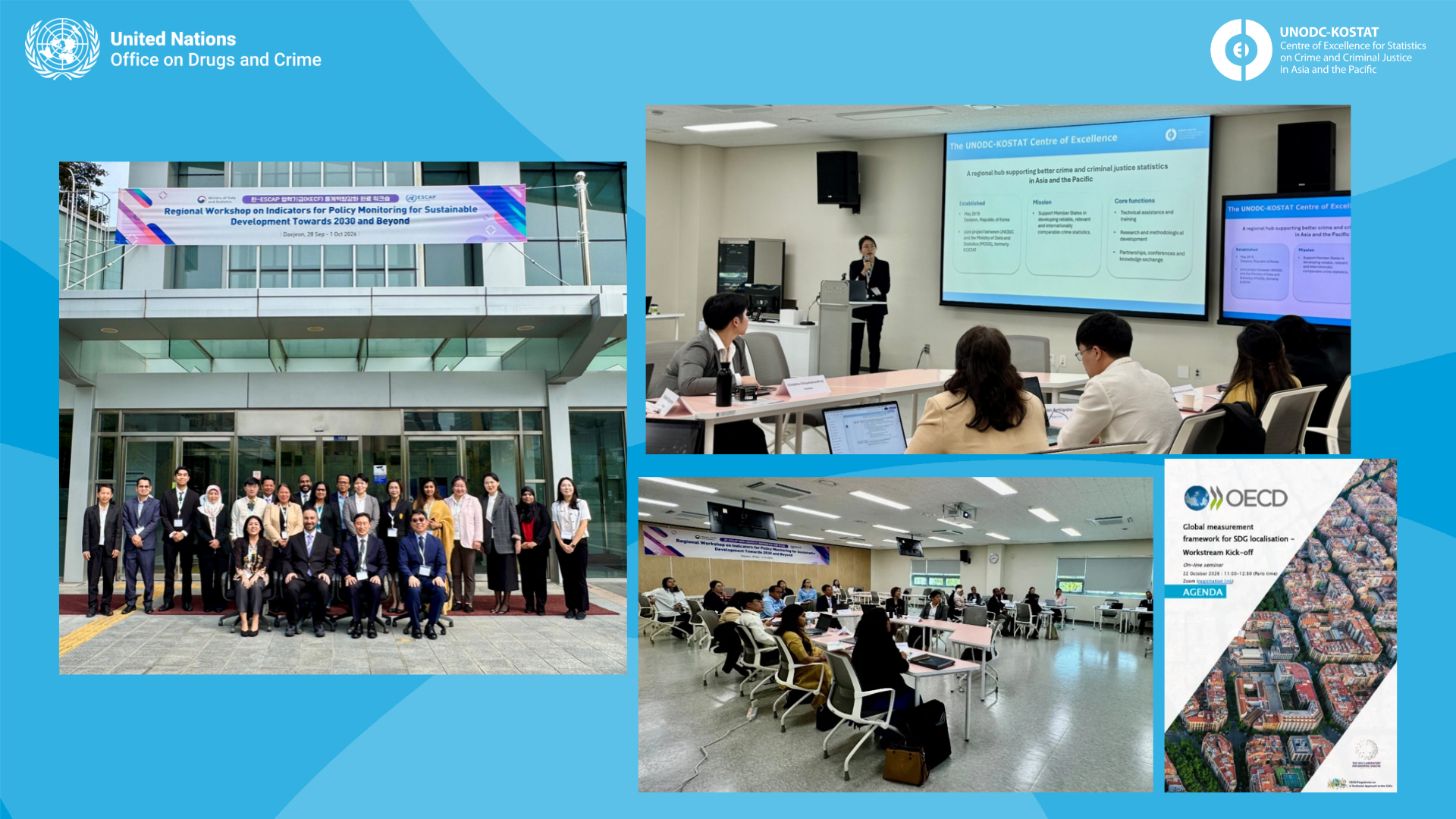
With less than five years remaining to achieve the 2030 Agenda for Sustainable Development, the international community has begun reflecting on lessons learned from SDG implementation and monitoring. As a custodian agency for several SDG indicators, UNODC is actively contributing to these discussions. The UNODC-KOSTAT Centre of Excellence (CoE) for Statistics on Crime and Criminal Justice in Asia and the Pacific is supporting these efforts. Youngshil Park, Programme Coordinator of the UNODC-KOSTAT CoE, serves as co-lead of the Subnational SDG Monitoring Workstream under the Task Team on Lessons Learned from SDG Monitoring (IAEG-SDGs TT), which is coordinated by Inter Agency and Expert Groups on SDG indicators (IAEG-SDGs). Through this role, she contributes to identifying success and challenge, and lessons from national and local SDG monitoring processes.
Virtual, 22 October, Contributing to the Global Stocktake on SDG Localisation
On 22 October, Youngshil Park participated as a speaker at the online seminar "Global Measurement Framework for SDG Localisation - Workstream Kick-off", jointly organized by UN-Habitat and the Organization for Economic Co-operation and Developmen(OECD) with support from the Italian Ministry of the Environment and Energy Security (MASE).
The event launched a new workstream under the OECD Geospatial Lab to develop a Global Measurement Framework for SDG Localisation as part of the broader OECD-UN-Habitat Global Stocktake on SDG Localisation. The initiative brings together policymakers, international organizations, and technical experts to strengthen approaches for measuring SDG progress at local and regional levels.
During the session, Youngshil presented the ongoing work of the IIAEG-SDGs TT in capturing lessons learned from SDG monitoring at global, national, and subnational levels. She highlighted the overall process of gathering lessons learned from multi-statkeholders and discussed how these insights could support future international discussions on the post-2030 development agenda.
Daejeon, Republic of Korea, 28 September – 1 October, Bringing Regional Perspectives to Beyond 2030 Discussion
The CoE also contributed to the Regional Workshop on Indicators for Policy Monitoring for Sustainable Development Towards 2030 and Beyond, held from 28 September to 1 October in Daejeon, Republic of Korea. This workshop was co-organized by Ministry of Data and Statistics (MODS) of Republic of Korea MODS and Economic and Social Council of Asia and the Pacific (ESCAP).
The workshop brought together 16 participants from eight countries, including Brunei Darussalam, Cambodia, Lao PDR, Maldives, Mongolia, the Philippines, Sri Lanka, and Thailand, representing both national statistical offices and policy institutions.
As part of the workshop, a session on lessons learned from SDG monitoring was conducted. Youngshil Park delivered presentation on ongoing global process of compiling lessons learned from SDG monitoring and then she, together with the CoE staffs, facilitated group discussion on experiences and lessons at the international, national, and subnational levels. Participants exchanged experiences on the use of indicators for policymaking and discussed challenges and opportunities in strengthening monitoring systems
The workshop concluded with Asia-Pacific Recommendation for the next global agenda on the indicator framework, custodianship on indicators, national coordination, and Voluntary National Review (VNR)/Voluntary Local Review (VLR) processes. These recommendations are expected to contribute to stronger evidence-based decision making.
Through its engagement in both global and regional platforms, the UNODC-KOSTAT CoE continues to contribute practical evidence and lessons learned from SDG monitoring. These discussions will help inform international efforts to strengthen monitoring systems, support policy implementation, and shape the development agenda beyond 2030.