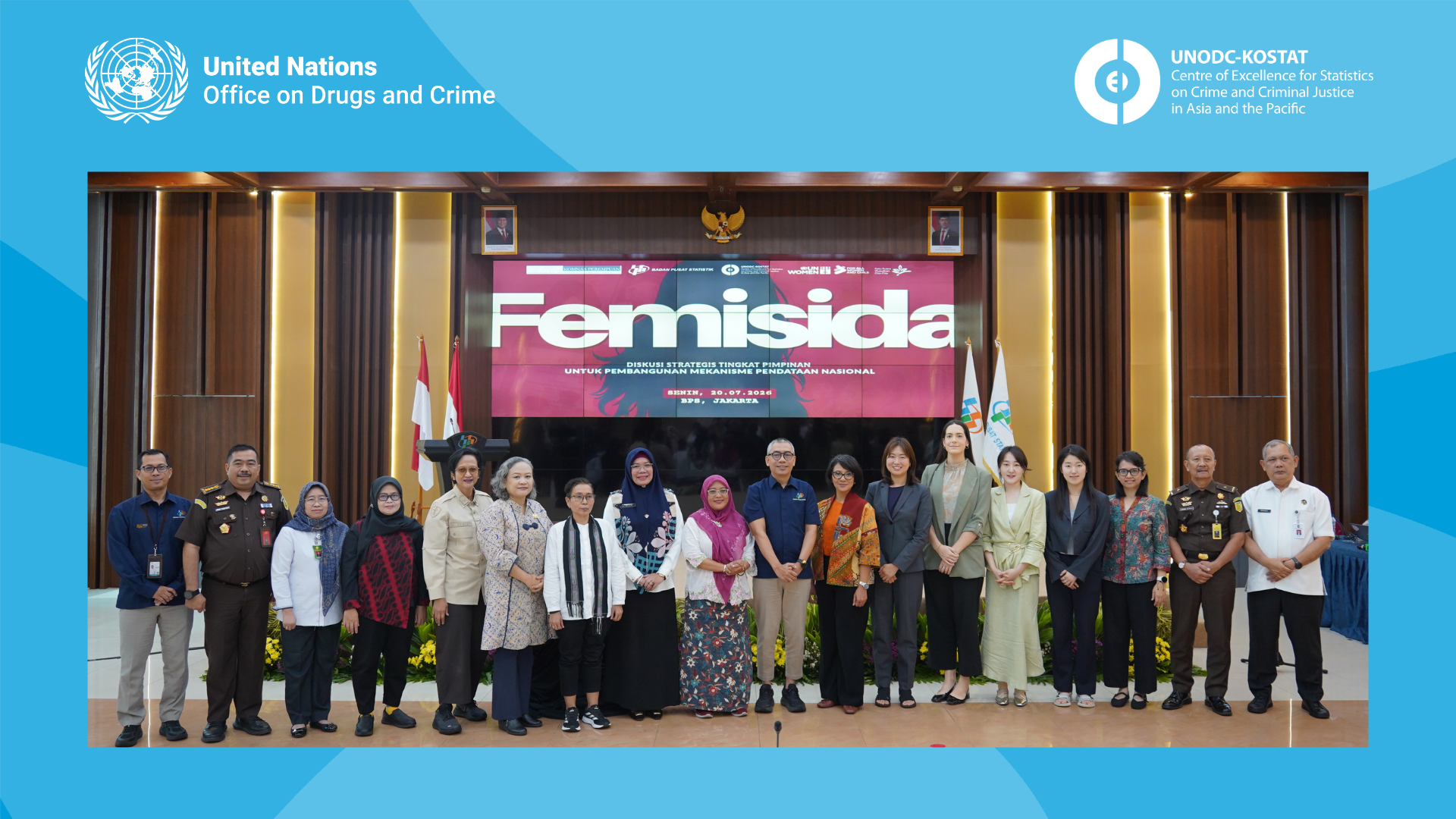
Jakarta (Indonesia), 20-25 July 2026 – The UNODC-KOSTAT Centre of Excellence for Statistics on Crime and Criminal Justice in Asia and the Pacific (CoE), in collaboration with the UN Women Knowledge and Partnerships Centre in the Republic of Korea, the National Commission on Violence Against Women (Komnas Perempuan) and BPS-Statistics Indonesia, launched an implementation initiative to support the application of the “Statistical Framework for Measuring the Gender-Related Killing of Women and Girls (also known as femicide/feminicide)” in Indonesia.
The initiative builds on the Statistical Framework jointly developed by UNODC and UN Women to promote a standardized approach to measuring gender-related killings of women and girls. Endorsed by the UN Statistical Commission in 2022, the Framework encourages countries to collect information on the circumstances and context of killings to better identify gender-related motivations and support evidence-based prevention policies.
The project brought together national institutions involved in the collection, production, analysis and dissemination of intentional homicide and femicide-related data. It aimed to map existing data sources and institutional responsibilities, assess the availability and comparability of relevant information, and identify opportunities to strengthen coordination and the measurement of gender-related killings across the criminal justice system.
The initiative was launched through an inter-agency kick-off meeting convened by Komnas Perempuan and BPS-Statistics Indonesia, bringing together representatives from criminal justice institutions, government ministries, statistical authorities, forensic services, civil society and academia. UNODC and UN Women introduced the Statistical Framework, outlining its origins, key principles and implementation process, and highlighted its importance as a standardized approach to identifying and measuring gender-related killings. Participants reviewed Indonesia’s existing operational definition of femicide and eight national indicators of gender-related motivation, developed starting from the UN definition, while discussing how these concepts could be applied throughout the criminal justice process.
Over five days, bilateral consultations were held with the Indonesian National Police, Attorney General’s Office, BPS-Statistics Indonesia, forensic services, the Supreme Court Registrar, the Directorate General of General Courts, and the Ministry of Women’s Empowerment and Child Protection. Discussions examined the availability and structure of information at different stages of the justice process, from initial police reports and investigations through prosecution, court proceedings and forensic examination.
The consultations concluded with Komnas Perempuan and BPS-Statistics Indonesia agreeing to act as champion organizations for the initiative. Komnas Perempuan will contribute substantive expertise on femicide, gender-based violence and gender-related indicators, while BPS will lead work on statistical standards, metadata, business processes and coordination with national data producers through the One Data Indonesia framework. Through technical discussions and bilateral consultations, the CoE supported national partners in identifying practical entry points for applying the Framework within existing statistical and administrative systems, facilitating the adaption to the Indonesian context.
The initiative marks an important step toward establishing a coordinated and standardized approach to measuring gender-related killings in Indonesia. As next steps, the partners will assess the availability and comparability of relevant data and disaggregating variables, identify differences between current national practices and the Statistical Framework, and organize a workshop to review the preliminary findings.