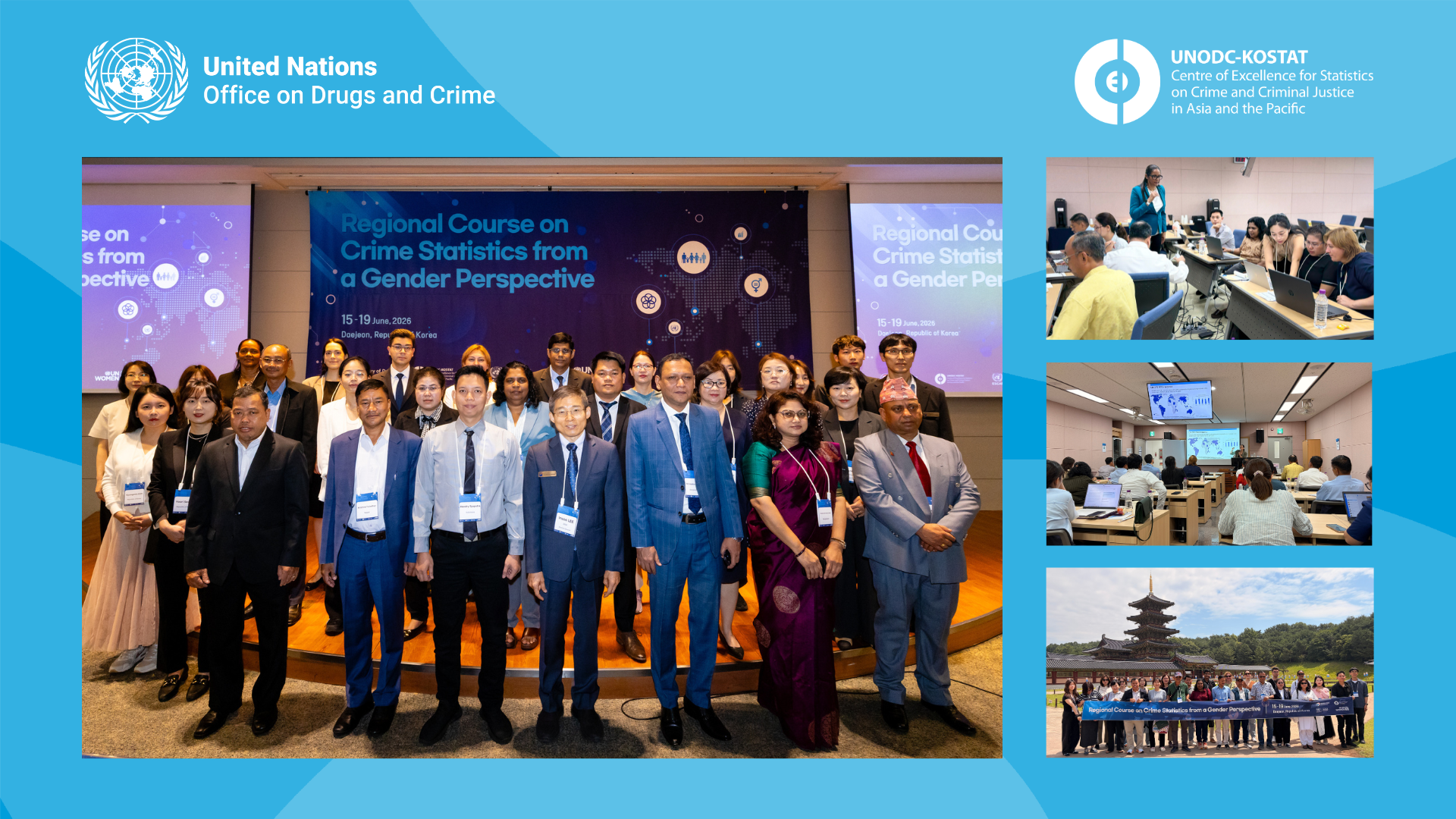
Daejeon (Republic of Korea), 15-19 June – Strengthening the production of gender-responsive crime statistics has become increasingly urgent as countries across Asia and the Pacific confront evolving forms of violence against women and girls, ranging from gender-related killings (femicide/feminicide) to rapidly expanding technology-facilitated abuse. Against this backdrop, the UNODC-KOSTAT Centre of Excellence for Statistics on Crime and Criminal Justice in Asia and the Pacific (CoE), the Statistical Institute for Asia and the Pacific (SIAP), and the UN Women Knowledge and Partnerships Centre in the Republic of Korea, with support from the Ministry of Data and Statistics (MODS, formerly KOSTAT), organized the Regional Course on Crime Statistics from a Gender Perspective in Daejeon, Republic of Korea.
The five-day regional training brought together experts from national statistics offices and criminal justice institutions from 9 countries across Asia: Azerbaijan, Bangladesh, Cambodia, Indonesia, Lao People's Democratic Republic, Nepal, Republic of Korea, Sri Lanka and Viet Nam. The course built on a series of successful online and face-to-face training initiatives delivered between 2020 and 2025, such as the e-Learning course “Crime Statistics from a Gender Perspective 3.0”, continuing efforts to strengthen national capacities to produce high-quality crime and criminal justice statistics for Sustainable Development Goal (SDG) monitoring.
The training was held at a time when significant data gaps continue to hinder effective responses to gender-based violence. According to joint estimates by the United Nations Office on Drugs and Crime (UNODC) and UN Women, at least 17,400 women and girls in Asia were killed by an intimate partner or family member in 2024 – approximately 48 every day (full report: Femicides in 2024: Global Estimates of Intimate Partner/Family Member Femicides). At the same time, technology-facilitated violence against women and girls (TFVAW) remains widely under-measured due to limited definitions, inconsistent reporting mechanisms and insufficiently integrated data systems. Addressing these gaps is essential to achieving SDG 5 on Gender Equality and SDG 16 on Peace, Justice and Strong Institutions.
Throughout the course, participants explored the importance of integrating a gender perspective into the production, analysis and dissemination of crime and criminal justice statistics. Sessions introduced key gender concepts and statistical frameworks that support evidence-based policymaking and strengthen countries' capacities to produce gender-responsive SDG indicators. Participants examined the relationship between gender and crime patterns, discussed data needs at national, regional and international levels, and assessed the strengths and limitations of different data sources used to measure crime and violence.
Special attention was given to emerging global priorities, including the Statistical Framework for Measuring the Gender-related Killing of Women and Girls (Femicide/Feminicide), jointly developed by UNODC and UN Women, and ongoing international efforts to measure TFVAW. Through interactive discussions, participants considered the methodological challenges associated with these forms of violence and explored approaches for improving measurement and reporting systems.
The course combined presentations, quizzes, group discussions and hands-on exercises to encourage active learning and peer-to-peer exchange. Participants shared country experiences in collecting, producing and disseminating crime and criminal justice statistics, highlighting common challenges and lessons learned. To strengthen practical skills, advanced statistical analysis sessions were conducted using R software. Participants involved in data production worked with microdata and recent household survey datasets to generate gender- and crime-related SDG indicators in line with international standards.
By the end of the training, participants had enhanced their understanding of gender-responsive statistical frameworks and strengthened their technical capacity to produce and analyse crime statistics that better capture the experiences of women and girls. The course also fostered stronger interagency collaboration between national statistical systems and criminal justice institutions, supporting more coherent approaches to data sharing, methodological alignment and SDG reporting.
The CoE remains committed to supporting countries across Asia and the Pacific in developing integrated, high-quality crime and gender statistics systems by strengthening national capacities and promoting regional cooperation.