Asan (Republic of Korea), 11–12 December 2025 – Over two days, the UNODC–KOSTAT Centre of Excellence (CoE) held meetings and participated in the Autumn Annual Conference of the Korean Criminological Association (KCA), to promote the CoE’s work within the domestic academic and practitioner community and strengthen opportunities for collaboration.
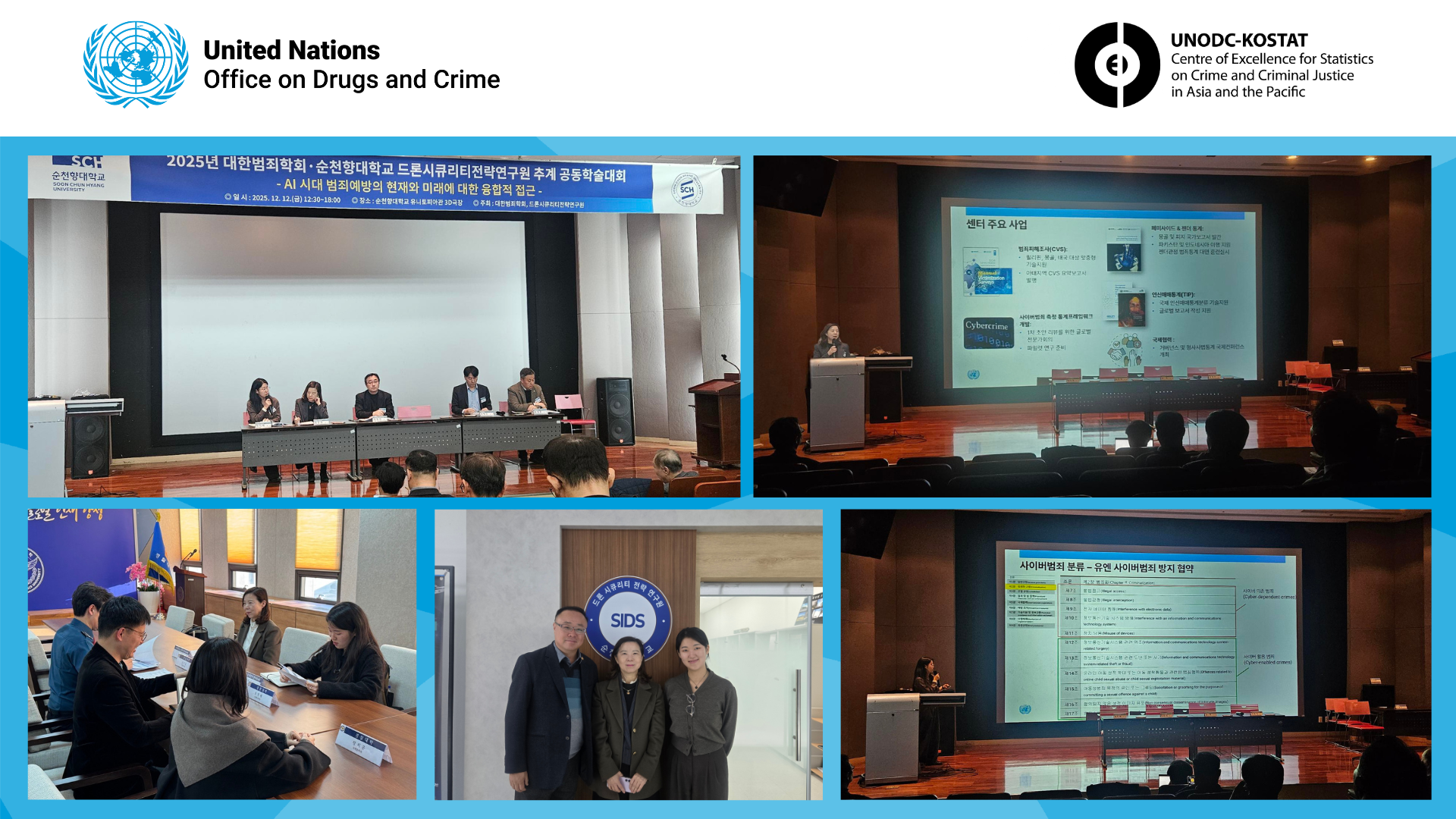
On 11 December, the CoE met with the Planning and Cooperation Division of the Korean National Police University (KNPU) to exchange views on potential collaboration, particularly in the areas of capacity building and training. As KNPU plays a key role in educating police officers and supporting international training initiatives, discussions focused on ways to integrate the importance of crime and criminal justice statistics, as well as international statistical standards, into relevant training programmes. Both sides agreed to explore the inclusion of crime and criminal justice statistics modules within existing curricula, as well as the potential for jointly developing new courses, as needed.
On the morning of 12 December, the CoE visited the Drone Security Strategy Institute at Soonchunhyang University to gain insights into drone-related crimes from the perspective of measuring cybercrime. Byung Seok Lee, Head of the Institute, introduced the Institute’s mandate, ongoing research, and future plans to strengthen collaboration among academia, researchers, and practitioners. Discussions focused on emerging technology-related risks and the growing relevance of drone-related incidents and offences in the broader context of cybercrime and digital security. There was a shared understanding to explore future collaboration on the development of classifications and measurement indicators for drone-related cybercrime, in the context of the Statistical Framework to Measure Cybercrime.
In the afternoon, the CoE participated in the KCA Autumn Annual Conference, held under the theme “Collaborative Approaches to the Present and Future of Crime Prevention in the AI Era.” The conference addressed a wide range of timely issues, including advanced technologies and security challenges, the use of AI and data in crime analysis and prevention, and emerging trends in criminology and criminal justice. It also served as a valuable platform for academic exchange and networking with Korean criminologists, early-career researchers, and practitioners working on contemporary crime issues.
As part of the conference programme, the CoE delivered a presentation in the session, “AI·Data-Based Crime Analysis and Strategies for Future Crime Prevention.” Jonghee Choi, Coordinator of the CoE, provided an overview of the Centre’s mandate and activities, followed by Jiae Park, Statistical Officer of the CoE, who presented the Centre’s work on developing the Statistical Framework to Measure Cybercrime. The subsequent discussion featured experts from Chungnam National University and Baekseok University as discussants, with exchanges focusing on key challenges in framework development and strategies for encouraging broader country engagement and adoption.
Following the mission, the CoE will continue engaging with domestic partners and the KCA community to strengthen academic exchange, disseminate international standards on crime and cybercrime statistics, and identify opportunities for collaboration—particularly in capacity building, research exchange, and expert consultations that can support the feasibility and practical application of the cybercrime measurement framework.
Further information on the CoE can be found here, X @CoE_UNODC and Facebook @UNODC.KOSTAT.CoE.