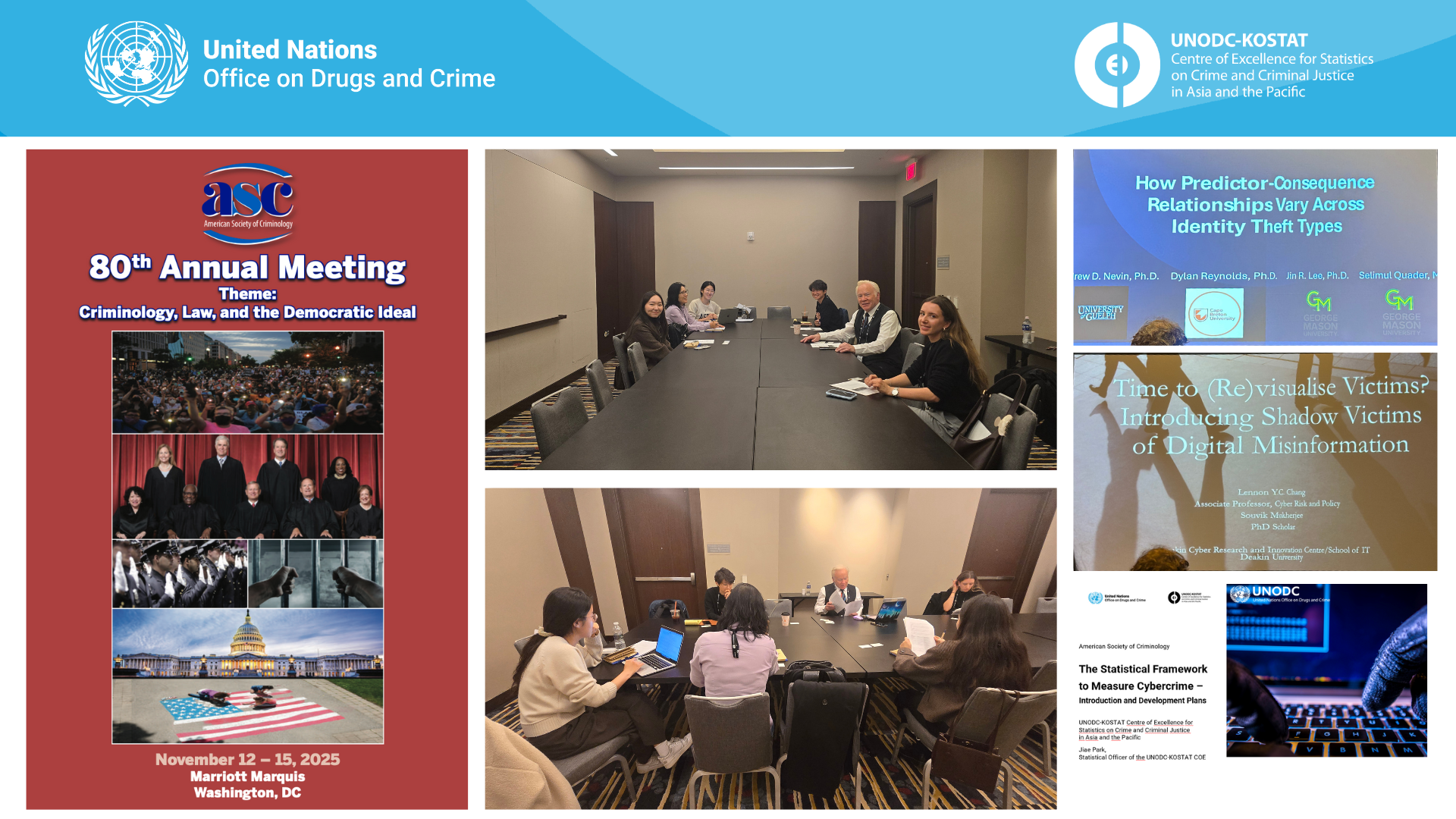
Washington, D.C. (United States of America), 12–15 November 2025 – The American Society of Criminology held its 80th Annual Meeting in Washington, D.C. under the theme “Criminology, Law, and the Democratic Ideal.” As one of the largest criminology conferences worldwide, the meeting brought together scholars and practitioners to engage in critical dialogue across research, education, policy, practice, and community, with the shared aim of advancing evidence-based justice.
Among the wide range of topics addressed, cybercrime featured prominently throughout thematic panels, regular sessions, roundtables, and poster presentations. The conference showcased innovative research on digital offending and victimization, including studies examining victimization across different types of cybercrime.
Several sessions introduced research examining the social, psychological, and situational contexts that can give rise to cybercrime, including online environments, routine activities, and decision-making processes in digital settings. Other contributions explored the evolving and increasingly complex mechanisms of cybercrime, while also noting that its impacts extend beyond financial loss to include psychological harm, particularly in cases such as identity theft.
Building on these discussions, Jiae Park, Statistical Officer at the UNODC–KOSTAT Centre of Excellence (CoE), convened a roundtable titled “Building Cybercrime Statistics – Global Needs and Country-Level Approaches.” The roundtable brought together experts from the CoE, the Korean Institute of Criminology and Justice (KICJ), the University of Alabama at Birmingham, the John Jay College of Criminal Justice, Illinois State University, and other academic and research institutions.
The session was chaired by Jisun Choi (KICJ), after which Jiae Park presented the CoE’s ongoing work on developing a statistical framework to measure cybercrime. The presentation outlined the background and rationale of this work, including its alignment with the UN Convention against Cybercrime and the International Classification of Crime for Statistical Purposes (ICCS), as well as progress to date and future plans. Discussions underscored the practical challenges countries face in producing reliable and comparable cybercrime statistics, and highlighted the importance of a clear, workable typology and a phased approach to indicator development that reflects national capacities and implementation realities.
Going forward, the CoE will continue to follow up with experts engaged during the ASC Annual Meeting and integrate relevant research insights into the development of the cybercrime statistical framework. This includes strengthening cross-regional partnerships, testing feasibility through consultations and pilot activities, and further refining the framework so that it can serve as an international guideline, supporting both cross-national comparability and national statistical capacity building.
Further information on the CoE can be found here, X @CoE_UNODC and Facebook @UNODC.KOSTAT.CoE.