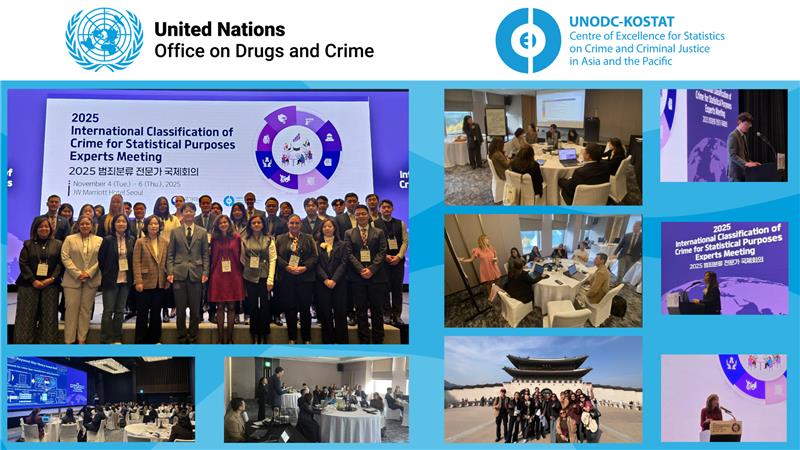
Seoul (Republic of Korea), 4-6 November 2025 – The CoE held a meeting for global experts in implementing the International Classification of Crime for Statistical Purposes (ICCS) over the course of three days in Seoul, Republic of Korea, bringing together experts from national statistical offices, criminal justice institutions, academia, and international organizations to review progress, share country experiences, and discuss future directions for the classification.
Since its adoption by the United Nations Statistical Commission in 2015, the ICCS has supported countries in producing more consistent, comparable, and policy-relevant crime statistics. The Expert Meeting aimed to review national experiences with ICCS implementation, exchange technical feedback on its current version, explore approaches to strengthen regional and global comparability of crime statistics, and identify areas where additional methodological guidance or revisions may be needed. Particular attention was given to the measurement of cybercrime, including whether the ICCS provides a sufficient foundation and the potential value of developing a dedicated statistical framework based on the classification.
The meeting opened with welcome remarks from Myoungho Lee, Deputy Minister of the Ministry of Data and Statistics, Angela Me, Chief of UNODC’s Research and Trend Analysis Branch, and Jonghee Choi, Coordinator of the CoE. Speakers highlighted the importance of high-quality crime and criminal justice statistics for evidence-based policymaking and emphasized the role of the ICCS in enabling international comparability. Initial sessions provided an overview of UNODC’s research activities, the mandate and work of the CoE, and the structure, use, and global implementation of the ICCS, including supporting methodological tools and guidance materials.
Participants examined national adaptations of the ICCS, including the Korean Classification of Crime for Statistical Purposes (KCCS), aligned with the ICCS. Presentations illustrated how national classifications can support consistent data production across institutions and showcased innovative approaches, such as the use of artificial intelligence for automated crime classification. Experiences from other regions highlighted the application of ICCS principles in related frameworks, including the Statistical Framework for Measuring the Gender-Related Killing of Women and Girls and the International Classification for Administrative Data on Trafficking in Persons, demonstrating how the classification can be adapted to address specific policy priorities while strengthening institutional coordination.
Discussions also focused on emerging areas, particularly the development of a statistical framework to measure cybercrime. Participants explored how ICCS categories can be used as a basis for measuring cyber-dependent and cyber-enabled crimes through administrative data and surveys, while addressing definitional and methodological challenges. National experiences from Asia-Pacific and other regions illustrated the institutional arrangements, technical steps, and collaborative mechanisms required to successfully implement the ICCS, including mapping exercises, validation of correspondence tables, and linking administrative and survey data.
Further sessions highlighted country experiences from the Dominican Republic, Ecuador, Thailand, the Philippines, and the Republic of Korea, emphasizing the importance of sustained technical work, inter-agency coordination, and the use of dashboards and dissemination tools to support policy use. UNODC’s support for measuring drug-related offences and aligning drug data with ICCS categories and indicators was also presented, highlighting its relevance for Sustainable Development Goal reporting.
The final day focused on reflections on the future of the ICCS. Participants discussed emerging crime types, cross-cutting categories, and the integration of disaggregating variables, and provided technical feedback on areas where clearer guidance, harmonized practices, and refined classification rules would strengthen the ICCS’s practical usability. The meeting concluded with the collection of expert input to inform the global ICCS review process and the further development of a cybercrime measurement framework.
The meeting reaffirmed the importance of strengthening regional and country-level collaboration on ICCS implementation and contributing to ICCS revisions to improve the international comparability of crime statistics. Through the exchange of experiences and technical feedback, participants helped identify areas where the classification can be further refined to better support national applications, as well as support UNODC can offer. Looking ahead, the discussions emphasized the need to develop a statistical framework for cybercrime, including completing an initial framework through regional and global expert meetings and conducting pilot studies in selected countries in the region, building on the ICCS as a common methodological foundation.
Further information on the CoE can be found here, X @CoE_UNODC and Facebook @UNODC.KOSTAT.CoE.