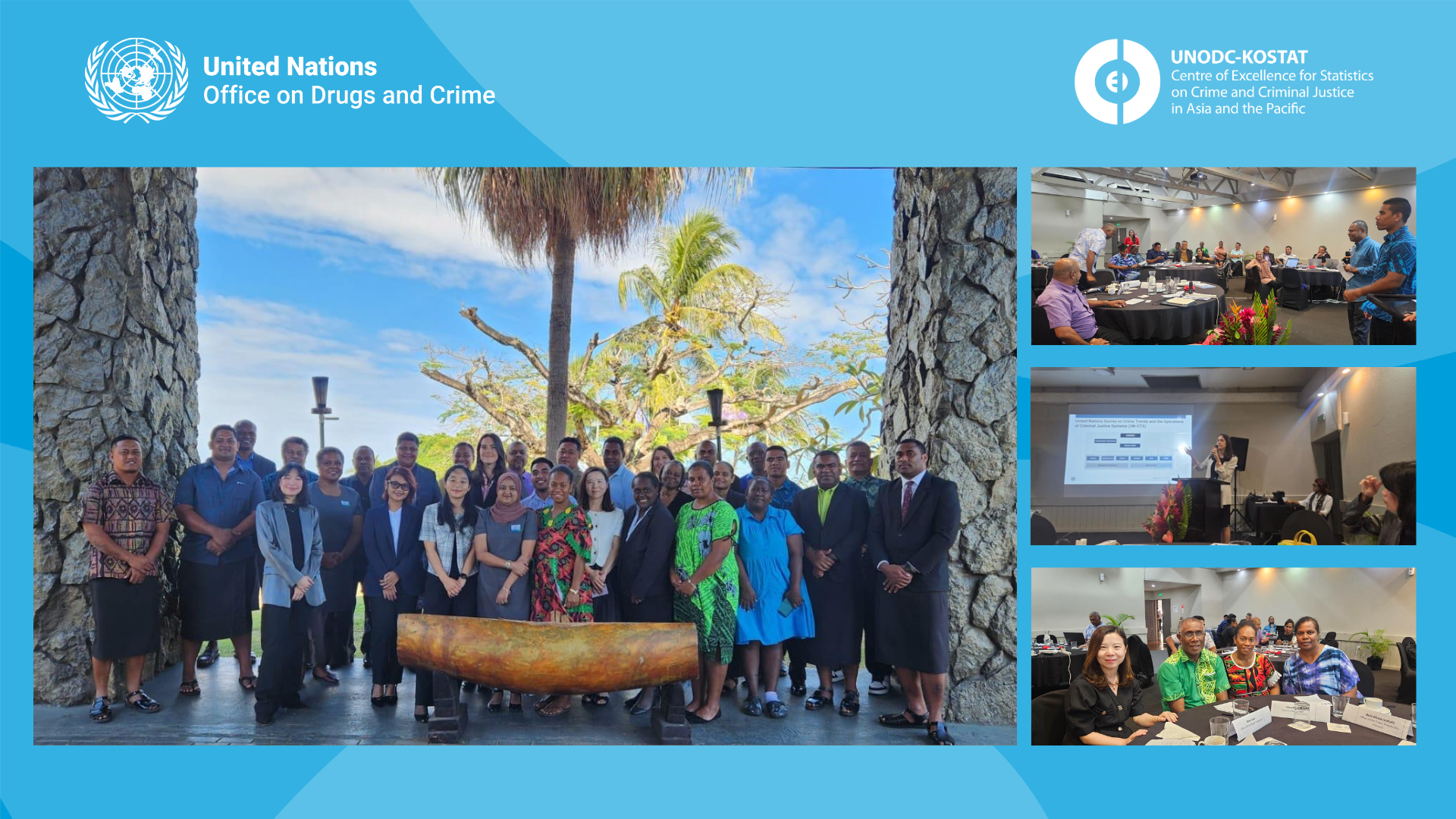
Nadi (Fiji), 22-25 September 2025 – The CoE, in collaboration with the Pacific Community (SPC) and the UNODC Regional Office for Southeast Asia and the Pacific (ROSEAP), organized a regional training on the implementation of the International Classification of Crime for Statistical Purposes (ICCS) and the Crime Victimization Survey (CVS) for Pacific Island countries.
The workshop was organized to promote the use of standardized statistical classifications for crime and criminal justice data, introduce the benefits of harmonized methodologies, and provide practical guidance on ICCS and CVS implementation. Participants represented national statistical offices, law enforcement agencies and criminal justice institutions from nine Pacific Island countries: Fiji, Kiribati, Nauru, Papua New Guinea, Samoa, Solomon Islands, Tonga, Tuvalu and Vanuatu.
Jonghee Choi, Coordinator of the CoE, noted that this training was particularly meaningful as it marked the Centre’s first in-person activity in the Pacific region. She highlighted the importance of meeting face-to-face after years of mostly online support and expressed appreciation to the nine Pacific Island countries for their strong commitment. She also acknowledged the support of ROSEAP and SPC and emphasized that the workshop would strengthen technical capacity, foster regional cooperation, and help address key data gaps related to SDG monitoring.
Over four days, the workshop combined presentations and hands-on exercises. SPC highlighted key regional challenges such as data gaps and the absence of local terminology for offences like corruption, helping trainers tailor the workshop to Pacific contexts. Participants were introduced to the ICCS, UNODC tools, and the importance of standardized crime statistics, and worked on mapping national legal provisions to ICCS categories, revealing inconsistencies across institutions.
Sessions covered disaggregation, ICCS implementation roadmaps, and gender-based violence (GBV). Participants were also introduced to the Statistical Framework for Measuring the Gender-Related Killing of Women and Girls (Femicide/Feminicide), including methodological considerations, data sources, and its relevance for SDG monitoring and policy development in the Pacific context. Countries drafted preliminary ICCS implementation plans, with Fiji sharing its experience establishing an inter-agency working group.
Trainers introduced the UN Crime Trends Survey, UNODC drug data tools, and the Crime Victimization Survey (CVS), emphasizing its value in capturing unreported crime. Participants learned about questionnaire design, survey planning, sampling, and field operations.
New Caledonia presented its CVS experience on the final day, followed by an exercise simulating interviewing challenges and discussing strategies to ensure data quality in small-population settings typical of Pacific Island countries.
The meeting fulfilled its objective of raising awareness of the need for standardized crime classifications, strengthening regional collaboration, and providing concrete examples and exercises to facilitate the understanding of ICCS and CVS implementation. Participating countries expressed strong interest in applying the tools presented and committed to sharing knowledge with relevant institutions at the national level. Countries were encouraged to continue engaging with SPC as the regional expert body and to establish national coordination mechanisms to support future ICCS and CVS implementation.
Further information on the CoE can be found here, Twitter @CoE_UNODC and Facebook @UNODC.CoE.