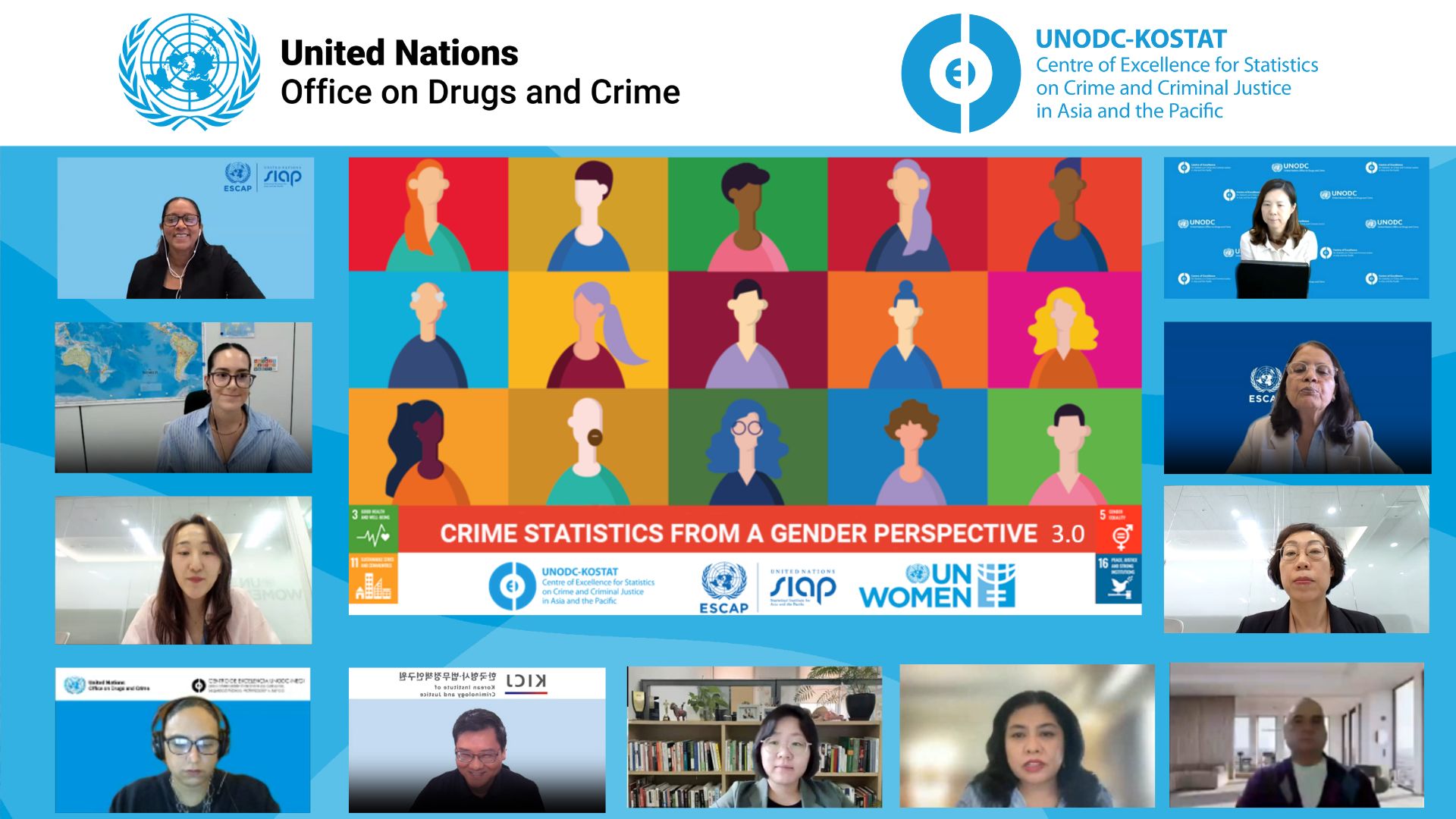
Daejeon (Republic of Korea) Virtual, 28 August – 3 October 2025 - The UNODC-KOSTAT Centre of Excellence for Statistics on Crime and Criminal Justice (CoE), in collaboration with the United Nations Statistical Institute of Asia and the Pacific (SIAP), and the UN Women Knowledge and Partnerships Centre in the Republic of Korea, delivered a facilitated course on the third edition of the jointly developed eLearning Crime Statistics from a Gender Perspective. The course aimed to strengthen regional capacity to produce, analyze, and disseminate crime and criminal justice statistics that integrate a gender perspective, supporting the monitoring of gender-related Sustainable Development Goals (SDGs) and evidence-based policymaking.
Building on the two previous editions held in 2020 and 2022, the 2025 course featured updated content across six modules reflecting recent methodological developments in crime and gender statistics. In addition to revisiting core concepts, the course introduced two new modules focusing on the measurement of the gender-related killing of women and girls (femicide/feminicide) and technology-facilitated violence against women (TFVAW). These additions responded to growing international attention to emerging forms of violence and the need for solid statistical frameworks to capture them.
The course targeted professionals working in crime and criminal justice statistics, including those responsible for data collection, production, analysis, and dissemination, as well as policymakers seeking to better understand the methodological foundations of gender-related crime indicators. Through interactive online modules hosted on the SIAP e-learning platform, participants explored gender concepts and analytical frameworks, examined the strengths and limitations of different data sources, and developed skills to produce gender- and crime-related SDG indicators using microdata. The course also provided a space for peer learning through an online discussion forum, encouraging the exchange of experiences across countries and institutions.
Complementing the self-paced modules, three live expert-led webinars offered participants practical insights into the application of statistical tools and frameworks. The webinars opened with welcoming remarks from representatives organizing institutions: Shailja Sharma, Director, SIAP, Jonghee Choi, Coordinator of the UNODC-KOSTAT CoE, and Yun-Jeong Hwang, Director of the UN Women Knowledge and Partnerships Centre in the Republic of Korea, who highlighted the importance of gender-responsive crime statistics for evidence-based policymaking and SDG monitoring. In her remarks, Jonghee Choi noted the growing recognition of the value of integrating a gender perspective in crime statistics and emphasized the continued collaboration between the CoE, SIAP, and UN Women in strengthening regional statistical capacity.
The first webinar focused on the practical application of the International Classification of Crime for Statistical Purposes (ICCS) and Crime Victimization Surveys, highlighting good practices and lessons learned from national experiences. The session featured presentations by Seong-Hoon Park, Director of Crime Statistics Research at the Korean Institute of Criminology and Justice, and Sudarak Suvannanon, from the Content and Public Communication at the Thailand Institute of Justice, who shared concrete examples of how administrative and survey data can be aligned to improve gender-sensitive crime statistics.
The second webinar addressed the practical application of the Statistical Framework to Measure the Gender-Related Killings of Women and Girls (femicide/feminicide). Claudia Pontoglio, Research Officer at the CoE, introduced the framework and its methodological foundations, followed by national and regional perspectives from Chuluunbat Sharkhuu, President of the Mongolian Institute for Protection and Security Studies, and Adriana Oropeza Lliteras, Coordinator of the UNODC–INEGI Center of Excellence. Speakers discussed institutional coordination, data disaggregation, and the use of the framework to support policy responses to femicide.
The third webinar focused on technology-facilitated violence against women (TFVAW), an emerging area of concern in many countries. Guest speakers included Sondang Frishka, Commissioner of the National Commission on Violence Against Women in Indonesia, and Professor Minkyung Han, Director of the Institute on Violence Against Women and Children at the Korean National Police University. The session, moderated by UN Women, explored conceptual and measurement challenges related to online and technology-enabled forms of violence, highlighting ongoing global efforts to develop comparable indicators and improve data availability.
Overall, the course provided participants with both conceptual foundations and practical tools to strengthen the integration of a gender perspective in crime statistics. By combining self-paced learning with expert discussions and country examples, the initiative contributed to building regional capacity to produce high-quality, policy-relevant statistics that support the monitoring of SDGs and inform responses to gender-based violence and emerging crime trends.
The CoE will continue strengthening regional capacity in producing high-quality data for crime and gender-based SDG targets and overall statistics, to inform policymakers at national and international level.
Further information on the UNODC-KOSTAT CoE can be found on our social media account: Twitter @CoE_UNODC and Facebook @UNODC.KOSTAT.CoE.